Wednesday, January 26, 2011

Top audi tts coupe cars

The Audi TT takes its name from the successful motor racing tradition of NSU in the British Isle of Man TT (Tourist Trophy) motorcycle race. NSU began competing in the TT in 1911, and later merged into the company now known as Audi.

The Audi TT also follows the NSU 1000TT, 1200TT and TTS cars of the 1960s in taking their names from the race.

The TT name has also been attributed to the phrase "Technology & Tradition
The styling of the Audi TT began in the spring of 1994 at the Volkswagen Group Design Center in California.[1] The TT was first shown as a concept car at the 1995 Frankfurt Motor Show.[2] The design is credited to J Mays and Freeman Thomas, with Hartmut Warkuss, Peter Schreyer,[3] Martin Smith and Romulus Rostcontributing to the award-winning interior design.

A previously unused laser beam welding adaptation, which enabled seamless design features on the first-generation TT, delayed its introduction. Audi did not initially offer any type of automatic transmission option for the TT. However, from 2003, a dual clutch six-speed Direct-Shift Gearbox (DSG) became available, with the United Kingdom TT variants becoming the world's first user of a dual clutch transmission configured for a right-hand drive vehicle, although the outright world first for a road car equipped with a dual clutch transmission was claimed earlier by a Volkswagen Group platform-mate, the left hand drive Volkswagen Golf Mk4 R32
audi tts coupe
audi tts coupe
audi tts coupe picture
audi tts coupe going on road
audi tts coupe showroom

audi tts coupe Video

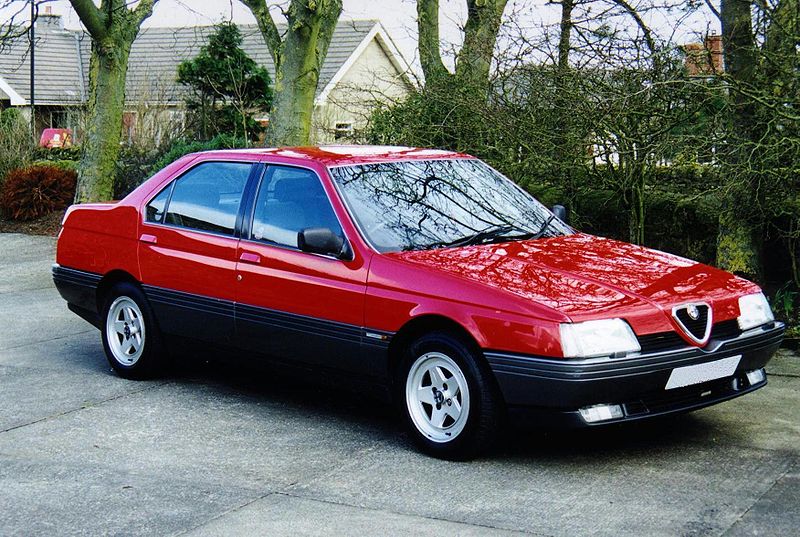
Alfa Romeo 164 Cars History

The Alfa Romeo 164 was styled by Pininfarina in 1987, shortly after completing the Ferrari Testarossa. The 164 can be seen to share several styling design ideas with the Ferrari expressed as a four-door saloon. In concern for heritage, the design is also the logical extension and successor of the Alfetta, particularly the late-model "long nose, square light".

The 164 was the first Alfa to feature extensive use of computer aided design for calculating structural stresses, resulting in a very rigid but still relatively lightweight body. The 164 was the basis of the Type Four chassis, which it shares with Lancia Thema, Fiat Croma and Saab 9000. Being the last to reach the market, the 164's bodyshell was the most aerodynamic of the four, and had a markedly sleeker profile and lower coefficient of drag. In order to permit this design variation, an exclusive front suspension was developed.

The 164 was the first of the "new technology" Alfa Romeos, and is the technological and styling basis of all Alfas to the present day.

The 164 also introduced dramatically improved build quality over previous Alfas, featuring galvanised steel frame and various body panels for the first time, ending the most common complaint by Alfa customers about rust problems encountered in older models such as the Alfasud and the GTV.

Even though some purists feared of loss of character due to the adoption of front-wheel drive for the first time in an Alfa top-line saloon, the car proved itself as a supremely comfortable and sure-footed car, with a distinctively sporting character, inline with the marque's tradition. In fact, the motorpress of the day found its only fault to be some torque steer, particularly in earlier versions.

Equipped with the most complex wiring loom of any Alfa Romeo, the 164 was designed to compete in the executive car segment dominated by the German cars.[3] It offered better value for money in terms of technology (having three onboard computers, one for air conditioning, one for instrumentation, and one for engine management; air conditioning and instrument functions shared a multiple-mode coded Z-80-class microcontroller for dashboard functioning). Air-direction within the ventilation system was controlled by a pair of servomechanisms, which were constructed using notoriously fragile plastic gears and were prone to failure; possible high part costs are alleviated by the commonality of these parts with the 166. At least one aftermarket company has also developed metal replacement gears which eliminates the breakage issue.

The car had some very advanced features for its day, such as automatic climate control and electronically controlled damping suspension (in the top-line Cloverleaf models and 164S). This suspension actively reduced damping in response to conditions to provide a dynamic compromise between road holding and comfort. The 164 also boasted engines rated among the best in the industry at the time, and the same basic engine designs were used until very recently by Alfa Romeo across its model range.
Alfa Romeo 164
Alfa Romeo 164 Showroom
Red Alfa Romeo 164
Alfa Romeo 164 Wallpaper
Alfa Romeo 164 Image
Alfa Romeo 164 Car

Monday, January 24, 2011

Ferrari F430

The Ferrari F430 is a sports car that was produced by the Italian automaker Ferrari from 2004 to 2009, as a successor to the 360. It debuted at the 2004 Paris Motor Show. Its replacement, the Ferrari 458 Italia, was unveiled on 28 July 2009 and is on sale now
The MSRP for a Ferrari F430 is $186,925 to $217,310 in the United States,£118,500 in the United Kingdom, approximately €175,000 in the European Union and $389,000 for the base model to $450,000 for the Spider F1 in Australia.
The body has been redesigned to be more curvaceous and aerodynamic. Although the drag coefficient remains the same, downforce has been greatly enhanced. A great deal of Ferrari heritage is found in the car: at the rear, the Enzo's tail lights and interior vents have been added. The car's name has been etched into the Testarossa-styled driver's side mirror. The large oval openings in the front bumper are reminiscent of Ferrari racing models from the 60s, specifically the 156 "sharknose" Formula One car and 250 TR61 Le Mans cars of Phil Hill.
The F430 features a 4.3L V8 petrol engine derived from a shared Ferrari/Maserati design. This new power plant is a significant departure for the F430 line: the engines of all previous V8 Ferraris were descendants of the Dino racing program of the 1950s. This fifty year development cycle came to an end with the entirely new 4.3L, the architecture of which is expected to replace the Dino-derived V12 in most other Ferrari cars. The engine's output specifications are: 490 PS (360 kW; 483 hp) at 8500 rpm and 465 N·m (343 lb·ft) of torque at 5250 rpm, 80% of which is available below 3500rpm. Despite a 20% increase in displacement , engine weight had grown by only 4kg and engine dimensions have decreased, for easier packaging. The conrods , pistons and crankshaft are all entirely new, the four-valve cylinder head , valve heads and intake trumpets directly takes measurements from F1 engines , for better volumetric efficiency. The F430 has a top speed of 196 mph (315 km/h).
The brakes on the F430 were designed in close collaboration with Brembo. The result has been a new cast-iron alloy for the discs. The new alloy includes molybdenum which has better heat dissipation performance. Another option Ferrari is providing are Carbon fibre-reinforced Silicon Carbide (C/SiC) ceramic composite discs. Ceramics have much higher resistance to heat and brake fade than metals, the F430's brakes offer not only good performance but also a longer lifespan. Ferrari claims the brakes will not fade even after 300-360 laps at their test track.

Chrysler PT Convertible

The Chrysler PT Cruiser is a retro styled compact automobile launched by Chrysler as a 5-door hatchback in late 1999 (for the 2000 model lineup) and as a 2-door convertible in early 2005 (for the 2005 model lineup).

Originally conceived as a Plymouth model, the PT Cruiser received the Chrysler nameplate on introduction in anticipation of the 2001 discontinuation of the Plymouth brand. The PT Cruiser was designed by Bryan Nesbitt, who later also styled the Chevrolet HHR.The name PT Cruiser includes the initialism PT, standing for "Personal Transport" and designating the car's platform as well as production code.

The convertible officially ceased production December 21, 2007, but the last 2007 convertibles were marketed as 2008 models. On January 12, 2009, Chrysler LLC, under the private equity Cerberus Capital Management investor, announced the gradual discontinuation of the main model.

On July 6, 2009, after reorganization into the "New Chrysler", the company changed plans to discontinue the model by specifying that it will do so for Canadian and Mexican markets only.[3] On July 9, 2010 the PT Cruiser ended production.Worldwide production totaled 1.35 million units


Caparo T1 Speed Cars

White Caparo T1
Caparo T1 going on road
Caparo T1

Caparo T1 Video
Caparo T1 wallpaper
Caparo T1 gallery

Thursday, January 13, 2011

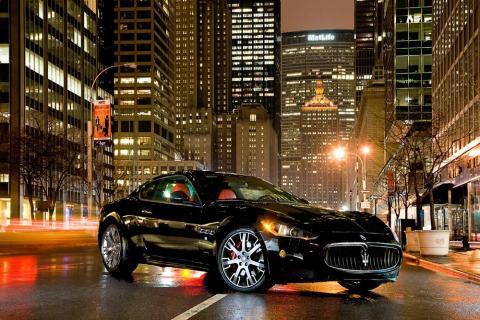
maserati granturismo cars

maserati granturismo pic
maserati granturismo image
maserati granturismo inside
maserati granturismo wallpaper
maserati granturismo front view

Tuesday, January 4, 2011

Muscle Car

Muscle car is a term used to refer to a variety of high performance automobiles. The term generally refers to American 2-door rear wheel drive mid-size cars, and sometimes full-size cars equipped with large, powerful, V8s, and sold at an affordable price for street use and both formal and informal drag racing.

As such, they are distinct from two-seat sports cars and expensive 2+2 GTs intended for high-speed touring and road racing.

Building on the American phenomenon and developing simultaneously in their own markets, muscle cars also emerged in their own fashions in Australia, South Africa, the UK, and elsewhere.

According to the June 1967 issue of Road Test magazine, a "muscle car" is "Exactly what the name implies. It is a product of the American car industry adhering to the hot rodder's philosophy of taking a small car and putting a BIG engine in it. The Muscle Car is Charles Atlas kicking sand in the face of the 98 hp (73 kW) weakling."Author of the book Muscle Cars the quote is drawn from, Peter Henshaw, furthers that the muscle car was designed for straight-line speed, and did not have the "sophisticated chassis", "engineering integrity" or "lithe appearance" of European high-performance cars

However, opinions vary as to whether high-performance full-size cars, compacts, and pony cars qualify as muscle cars