The original E34 M5 was introduced in September, 1988. The later 3.8-liter version first appeared at the 1991 Frankfurt motor show, as did the E34 M5 Touring.
Unlike the normal 5 Series, M5s were hand-assembled at the BMW Motorsport facility in Garching, a suburb of Munich. Bodies were pressed at the normal Dingolfing factory, then sent to Garching where they were mated with the engine and interior trim. The only exception was the South African-spec model, assembled at BMW's Rosslyn, South Africa factory from German-supplied Complete Knock Down (CKD) kits.
Versions and Production Numbers
The BMW M5 E34 was produced in two distinct versions, each with several variations. Early cars have a 3.6-liter (actually 3,535cc) version of the 24-valve S38 inline-6 known as the S38 B36. These were built in both left-hand and right-hand drive configurations, as well as a North American-specification edition. There were also a small amount of 3.6-liter M5s assembled in South Africa, exclusively for that market.
Starting in late 1991, the majority of European-spec M5 production (with the exception of some late 3.6-liter cars built for Japan and the Middle East) switched to a 3.8-liter (3,795cc) version of the S38 (designated S38 B38) and gained Adaptive M Suspension, plus a few cosmetic changes. The 3.8-liter M5s were available in both LHD and RHD variations, but there were no North American or South African editions. However, there was a small production run (891 built) of the E34 M5 Touring, or station wagon, all built to 3.8-liter European specification in left-hand drive.
* ECE 3.6 (LHD): 5,877 built from 9/88 thru 4/92
* ECE 3.6 (RHD): 524 built from 11/89 thru 11/91
* NA 3.6 (LHD): 1,678 built from 12/89 thru 4/93
* SA 3.6 (RHD): 265 built from CKD kits 9/90 thru 3/93*
* ECE 3.8 (LHD): 2,676 built from 12/91 thru 7/95
* ECE 3.8 Touring (LHD): 891 built from 3/92 thru 8/95
* ECE 3.8 (RHD): 343 built from 12/91 thru 6/95
*Figures indicate final completion date of vehicles assmebled in Rosslyn, South Africa.
Evolutions of the BMW M5 E34
Except for minor trim and equipment variations, there were few revisions to the original European-spec E34 M5 during its production. The first major round of changes occurred with the introduction of the more powerful 3.8-liter M5 in late 1991. Along with the larger engine, the 3.8-liter M5 brought Adaptive M Suspension, a reduced-effort clutch and a myriad of cosmetic alterations. Also, the M5 Touring was added at this time.
The final evolution of the E34 M5 entered production in May of 1994 and included the following upgrades:
* Getrag Type D six-speed manual gearbox
* Enlarged brake rotors with two-piece "floating" front calipers
* Nurburgring Package standardized with Servotronic steering as an option
* 18-inch M Parallel Spoke wheels
* Widened front "kidney" grilles with revised hood to match
BMW M GmbH produced 752 examples of the later E34 M5 3.8 six-speed, divided among the following configurations:
* ECE 3.8 sedan six-speed (LHD): 404 produced
* ECE 3.8 Touring six-speed (LHD): 209 produced
* ECE 3.8 sedan six-speed (RHD): 139 produced
Though the E34 M5 was introduced in North America as a 1991 model, production actually began in December of 1989. Cars produced before September of 1990 were therefore built to 1990 specification. Thus. the North American-spec E34 M5 did not actually adopt true 1991 specifications until approximately nine months after production began. At that time, the following items were modified:
* Rear center console deleted (became optional in Canada)
* Ellipsoid headlights and foglights replaced by "free form" versions
* Radio head unit updated to the later version (as used in other 1991 E34 models)
* Automatic climate control deleted (only used in some early 1991 E34 M5 examples)
* Tilt steering wheel added
* Light Silvergray leather upholstery offered in place of Silvergrey
For the 1992 model year (starting 7/91 production) the following changes were introduced:
* Rear axle ratio changed from 3.91:1 to 3.73:1 for better fuel economy
* Remote locking included as standard equipment
* ZF Servotronic (vehicle-speed sensitive) power steering in place of engine-speed sensitive version (USA models only)
* Reduced clutch pedal effort
* Door sill plates updated to the later design (from 01/92 production)
* Calypso Red metallic (252) paint available
For the final 1993 model year (starting 9/92 production), the North American M5 was given some cosmetic updates, many of which were first introduced on the Euro-spec 3.8-liter model:
* M System II ("throwing star") wheel covers replace M System I ("turbine")
* M-Technic side rear-view mirrors in place of the standard 5 Series versions
* Shadowline exterior trim in place of chrome
* Front exterior door handles embossed with "BMW Motorsport" text
* Birds-eye maple wood trim added in either a gray or black stain (not available in conjunction with the extended leather interior option on Canadian models)
* M tri-color stitching added to the airbag steering wheel rim
* Brilliant Red (308) paint replaced by Mugello Red (274)
* Lagoon Green metallic (266) and Avus Blue metallic (276) paints available (Lagoon Green for USA only)
Drivetrain
The early E34 M5 uses an evolution of the 24-valve inline-six found in the E28 M5 and E24 M635CSi/M6. Designated S38 B36, the engine technically remains a 3.5-liter, with a bore of 93.4mm (same as the previous engine) and a stroke of 86mm (up 2mm on the early S38) for a total capacity of 3535cc (up from 3453cc). The added stroke is due to a new forged steel crankshaft, though the camshafts were also changed. Compression is up slightly (10:1 versus 9.8:1). Further enhancements include:
* An electronically-controlled butterfly valve in the inlet manifold to provide better low-rpm and mid-range power
* Bosch Motronic fuel injection for precise metering of the air/fuel mixture
* Improved flywheel
* Equal length stainless steel headers
* Three way ceramic catalysts (similar to those used on the M70 V12 engine)
The S38 B36 is rated at 315 hp (DIN) or 310 hp (SAE) at 6,900 rpm and 266 lb/ft of torque at 4,750 rpm. Like the earlier S38 B35, it carries the "BMW M Power" inscription on its cam cover but the design of almost every component is different.
Unlike the engine used in the E28 M5, the S38 B36 engine in the E34 M5 was designed to meet all worldwide emission standards from the start. Therefore, the engines used in North American- and South African-spec E34 M5s are essentially the same as those used in the European-spec models.
The final evolution of the S38 powerplant, the S38 B38, was used in later versions of the E34 M5, none of which were sold in North America. In this application, the bore was increased (to 94.6mm) and the stroke lengthened (to 90mm), raising the displacement to 3,795cc. Though the added capacity makes the S38 B38 the largest six-cylinder production BMW engine of the modern era, it represents only a portion of the major revisions developed by BMW Motorsport at this time. Others include:
* Larger intake and exhaust valves
* Lighter pistons
* Shorter conrods
* Increased compression to 10.5:1
* Bosch Motronic 3.3 engine management system
* Distributorless ignition with six coils
* Redesigned intake and exhaust manifolds
* Revised throttle butterfly linked to Motronic engine control
* Dual-mass flywheel with harmonic balancer
* Metal catalysts for reduced backpressure and better heat conduction
The S38 B38 is normally rated at 340 hp (ECE)/347 hp (DIN) at 6,900 rpm and 295 lb/ft of torque at 4,750 rpm. However, a cleaner version was developed for Austria and Switzerland, rated at 334 hp (ECE) and later 327 hp (ECE). The S38 B38 can be identified by its grey (instead of black) cam cover surround.
Gearbox of the BMW M5 E34
All M5s built before May, 1994 have a Getrag 280/5 five-speed manual gearbox with the following ratios: 3.51 (1), 2.08 (2), 1.35 (3), 1.00 (4), 0.81 (5). These cars have a 3.91:1 final drive, with the exception of North American-spec E34 M5s built to 1992 and 1993 specification which have a taller 3.73:1 final drive for better fuel economy.
As of May, 1994 production, the five-speed was replaced with a Getrag Type D six-speed manual box with the following ratios: 4.23 (1), 2.52 (2), 1.66 (3), 1.22 (4), 1.00 (5), 0.83 (6). A taller 3.23:1 final drive was fitted at this time.
All E34 M5s have a standard limited slip differential with a maximum locking of 25 percent.
Chassis
The E34 M5’s chassis is based on the MacPherson strut/semi-trailing arm design of the normal E34 5 Series but incorporates the following changes from BMW Motorsport:
* 20mm reduction in ride height
* 25 percent firmer spring rates
* Firmer shock valving all around and self-leveling in the rear
* Thicker antiroll bars (25mm vs. 23mm in the front, 18mm vs. 15mm in the rear)
* Adjustable rear toe-in
All 3.8-liter M5s are further fitted with the Adaptive M Suspension, an M-tuned version of the Electronic Damping Control system that was introduced in the E32 7 Series. This system electronically chooses the optimum shock rates based on sensors that gather road speed, steering input, acceleration/deceleration loads and lateral body movements. Furthermore, M5s equipped with the Nurburgring package (standard from May, 1994) have a control switch on the dashboard to lock the Adaptive M Suspension into the firmest setting during aggressive driving.
Steering
Like all E34 5 Series, the E34 M5 uses a recirculating ball steering design, but the overall ratio is reduced from 16.2:1 to 15.6:1.
Two types of power assistance were offered: An engine-speed sensitive system was fitted to all European-spec 3.6-liter M5s and on North American models built before September, 1991. A vehicle-speed sensitive system developed by ZF and called Servotronic was available on European-spec 3.8-liter models as either a stand-alone option or as part of the optional Nurburgring Package. However, Servotronic was not included with the Nurburgring Package after it became standard equipment in May of 1994, but continued to be a vailable as an individual option. Servotronic was also fitted as standard to all North American-spec M5s built after September, 1991 (i.e. 1992 and 1993 model years).
Nurburgring Package
In addition to the standard Adaptive M Suspension fitted to all 3.8-liter M5s, the Nurburgring Package could be added as an extra cost option. This consisted of ZF Servotronic (vehicle-speed sensitive) power steering, a 19mm rear anti-roll bar, wider 255/40ZR17 rear tires on 9x17-inch alloy wheels (already standard on the Touring) and a control switch for the adjustable shocks that allowed them to be locked in the firmest position. This package became standard on all M5s as of May, 1994 production, with the exception of the Servotronic steering which became a separate option at this time.
Brakes
All M5s built before May, 1994 have upgraded vented front disc brakes measuring 12.4-inches. The rear rotors measure 11.8-inches in diameter and are vented as of 10/89 production. The May, 1994 update brought even larger front and rear brakes (now 13.6-inches and 12.8-inches, respectively) and the front rotors were changed to a two-piece "floating" design for better heat dissipation.
Wheels and tyres
There are two factory 17-inch wheels for the E34 M5, M System I and M System II. Both are a two-piece wheel with a forged five-spoke center and a cast rim covered by an outer cover. The only difference is the design of the outer cover, "turbine" for the M System I and "throwing star" for the M System II. This outer cover is interchangeable between the two M System wheels, making updating form the earlier style to the later style an easy (and therefore common) procedure.
The 3.6-liter M5 is equipped with 235/45ZR17 tires on 8x17-inch M System I wheels. However, for the 1993 model year, North American-spec M5s use the M System II design in the same size. In addition, wider 255/40ZR17 rear tires on 9x17-inch M System I wheels were available as an option in some markets (not North America).
All 3.8-liter M5 sedans built before May, 1994 are equipped with 235/45ZR17 tires on 8x17-inch M System II wheels. Sedans equipped with the optional Nurburgring Package and all Tourings use wider 255/40ZR17 rear tires on 9x17-inch M System II wheels.
All M5s built after May, 1994 have 245/45ZR18 tires on all four corners with staggered M Parallel Spoke wheels measuring 8x18-inches in the front and 9x18-inches in the rear. Note: Though nearly identical in style to the 18-inch M Parallel Spoke wheels later used on the E38 7 Series, the E34 M5 wheels have a matte silver finish and a unique offset.
Cosmetics
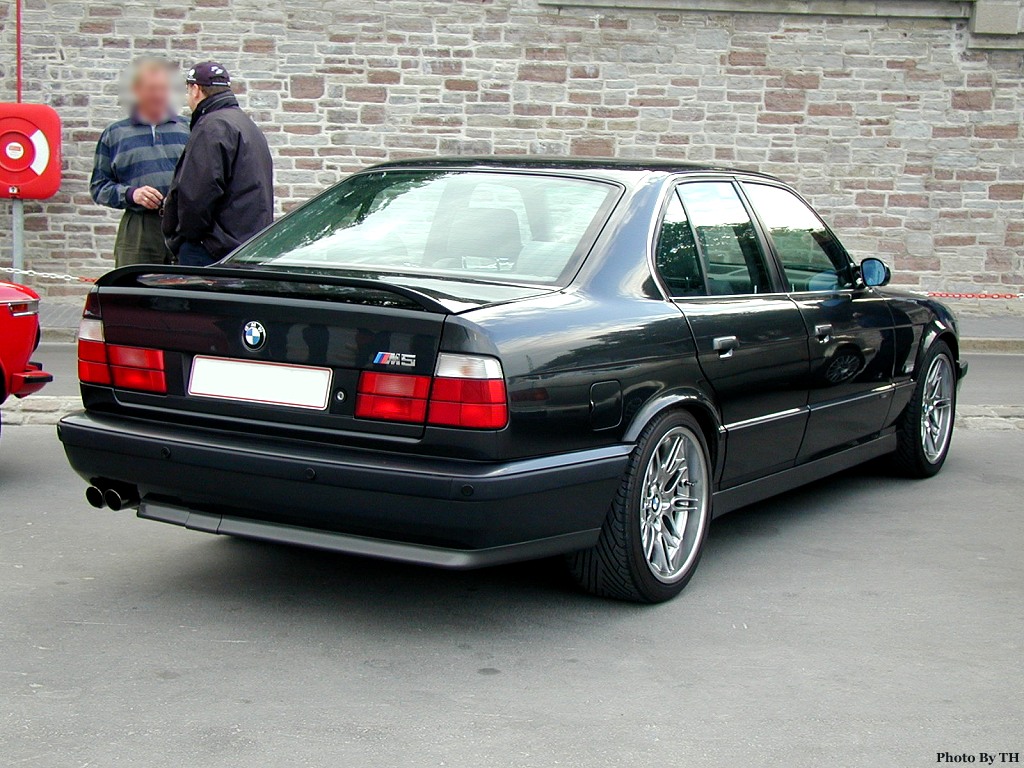
An E34 M5 is most easily distinguished from a normal 5 Series by its unique lower body panels that include a front airdam, side valances and rear diffuser. These are painted in a contrasting Diamond Black metallic (181), Sebring Grey metallic (229) or Granite Silver metallic (237), depending on the car’s exterior color and production date. In addition, the E34 M5 has large-diameter twin exhaust pipes and "M5" grille and decklid badges (only the former on M5s built after May, 1994). Like the previous E28 M5, these could be deleted upon request. Dechromed window trim (known as Shadowline) was optional on the E34 M5 in most markets, as was a body-color rear decklid spoiler. Starting with the production of the 3.8-liter model, the E34 M5 could be ordered (in most markets) with aerodynamic M rear-view mirrors (also fitted to all North American-spec E34 M5s for the 1993 model year). All E34 M5 sedans have a black plastic panel that fills in the gap between the taillights and the license plate. Though this panel was only fitted to M5 sedans, this same area on the M5 E34 Touring is covered in an exclusive textured black paint (instead of the normal body-color).
The E34 M5 was also the only regular production 5 Series to be fitted from the factory with 17-inch M alloy wheels in either a "turbine" style known as M System I (all 3.6-liter models and North American-spec cars up to 9/92) or a "throwing star" design known as M System II (all 3.8-liter cars up to 5/94 and North American-spec after 9/92). The final six-speed 3.8-liter M5s (from 5/94) use an 18-inch M Parallel Spoke design, also essentially unique to the M5 within the E34 range.
European version vs. North American versions vs. South African version
Aside from government-mandated safety features such as bumper-mounted side marker lights, North American cars are visually very similar to their Euro-market counterparts. The sole exception are 1993 models (built from 09/92-03/93). These have the exterior appearance of the European-spec 3.8-liter M5, but retain the 3.6-liter engine and chassis.
The South African-built M5s are cosmetically identical to the European-spec cars. However, like the South African-spec E28 M5s, their bodies were painted at BMW's Rosslyn factory, thus exterior paint choices may have been limited.
The wheels are the main exterior differentiator between a 3.6-liter E34 M5 and a later 3.8-liter model. The European-spec 3.6-liter M5s were all equipped with the M System I ("turbine") wheel design, while the 3.8 utilized the M system II ("throwing star") version until April, 1994. At that point, all M5s were upgraded to the 18-inch M Parallel Spoke wheels. (Note: North American-spec 1993 M5s use the later M System II wheel even though they are powered by the earlier 3.6-liter engine.)
In addition, the contrasting color of the lower aerodynamic body panels differed between the 3.6-liter and 3.8-liter M5 models. On the 3.6-liter examples ,these were painted either Diamond Black metallic (181) or Sebring Grey metallic (229). This changed with the 3.8-liter version to a choice of either Diamond Black metallic (181) or Granite Silver metallic (237). (Note: the change from Sebring Grey to Granite Silver also applies to the 1993 North American-spec E34 M5, which retained the 3.6-liter motor.)
Interior
Though the basic architecture of the interior is identical to that of any E34 5 Series, the M5 interior does have a few unique items: The unique instrument cluster contains red needles, an oil temperature gauge under the tachometer (instead of an economy gauge) and an M logo between the speedometer and tachometer. Like the E28 M5, there are "M5" trim plates on all four door sills (in one of two versions, depending upon the production date) and a fully-carpeted trunk with a storage compartment on the left side.
All E34 M5s are equipped with sport front seats, identical in shape and adjustment to those fitted as an option to other E34 5 Series models. Power controls were either standard or optional, depending upon the year and market. On European-spec M5s, the seats could be upholstered in a unique M cloth with leather boolsters on 3.6-lier models or a different M cloth with Amaretta suede bolsters on 3.8-liter models, as well as optional leather. Also, all E34 M5s built before September, 1990 have a fixed rear center console that effectively makes them four-seaters. This console became optional in most markets starting with September, 1990 production.
There were five different factory steering wheels available on the E34 M5, depending on the market and production date. Most 3.6-liter models and some early 3.8-liter cars have the three-spoke M-Technic II steering wheel without an airbag but with the M logo on the third spoke. Standard on U.S.-spec M5s and optional in most other markets (including Canada) was the regular airbag-equipped four-spoke BMW wheel. Starting with September, 1992 production, this wheel was upgraded to include the M tri-color stitching on the rim. Beginning with the 1994 model year (09/93 production), E34 M5s could be fitted with either an M-enhanced version of the four-spoke airbag wheel, now including a thicker rim with thumb grips and a revised center pad, or a new non-M three-spoke wheel with an integrated Euro-sized airbag. A leather-wrapped shift knob with an illuminated shift pattern and the M tri-color stripe was fitted as standard to all E34 M5s. Also, the area around the shift lever is unique in that it is recessed for extra storage.
Finally, all E34 M5s have a check control vehicle monitoring system integrated into the instrument cluster and the fourth-generation BMW on-board computer.
The interior of the 3.8-liter E34 M5 is essentially identical to the one found in 3.6-liter models. The main exception concerns the standard cloth upholstery. Early (3.6-liter) E34 M5s that are not equipped with optional leather upholstery have M cloth seats and door panels with leather on the outer bolsters, while the later (3.8-liter) cars have a different type of M cloth on the center part of the seats and door panels with a suede-like Amaretta material on the bolsters.
Also, 3.8-liter M5s have more pronounced door sill plates with the "M5" logo in a style similar to that of the E36 M3. (Note: North American-spec M5s built after 01/92 also have this design.)
Optional equipment
Like most other M models, the level of standard and optional equipment for the E34 M5 varies significantly from year to year and market to market. Major exterior options (standard in some markets) include power sunroof, metallic paint, heated headlight washers, Shadowline (dechromed) trim and a body-color rear spoiler. Like the E28 M5, the E34 M5's hand-built nature allowed even more variation on the interior. All regular E34 options were available, as well as various special types of upholstery, dash and console trims, and luxury items such as upgraded audio systems, phones, fax machines and televisions.
These special-order items were generally not availble in the North American market, where the E34 M5's option list was confined to heated front seats (standard in Canada), a CD changer, integrated cellular phone and remote locking with alarm (standard from 9/91 production) . One further rare option was the "Four-Seasons" glass moonroof, discontinued as of September, 1990. In addition, Canadian cars could further be fitted with a three-position memory for the driver's power seat and power steering column, extended leather upholstery and the fixed rear center console (standard on all North American cars built before September, 1990).
Special Versions
There were four official special editions of the E34 M5 sedan: The Cecotto, Winkelhock and "20 Jahre" editions were offered exclusively as left-hand drive European-spec models, while the right-hand drive UK Limited Edition was only sold in the United Kingdom. In addition, a special "NAGHI" edition of the E34 M5 sedan was produced for the Saudi Arabian market and an unofficial special edition of the M5 Touring, known as the "Elekta," was produced exclusively for Italy.
Cecotto edition
In 1991, BMW asked two of its racing drivers to design their own ideal version of an E34 M5. One of the drivers was multiple Touring Car champion Johnny Cecotto. His ideal M5 was one fitted with a full host of luxury items. BMW M then offered the public a package of features based on this ideal M5.
A total of 22 Cecotto M5s were produced. They were available in either Lagoon Green metallic (266) or Mauritius Blue metallic (287) and included the following special equipment:
* Servotronic power steering
* Full Bicolor Napa leather (Silvergray/Light Silvergray or Parchment/Light Parchment) including the steering wheel hub, column and horn pad
* Wood trim
* Power sunroof
* Heated, power front seats with driver's memory
* Heated rear seats (no center console) with power headrests
* Automatic climate control with microfilter
* Headlight washers
* Special leather service book pouch, key holder and gold pin
Winkelhock edition
In 1991, BMW asked two of its racing drivers to design their own ideal version of an E34 M5. One of the drivers was Joachim Winkelhock, known for his success on the racing circuit with the Schnitzer E30 M3. His ideal M5 was a lightweight edition, stripped of all but the most performance-oriented items. BMW M then offered the public a package of features based on this ideal M5.
A total of 51 Winkelhock M5s were produced, all painted Jet Black (668) with contrasting lower body panels in Sterling Silver metallic (244) and including the following special equipment:
* Smaller battery* (66 volt versus 85 volt)
* Smaller gas tank* (80 liters)
* Reduced sound deadening material*
* Deletion of power rear windows, rear headrests, fog lights, headlight washers, vanity mirrors*
* Wider 255/40ZR17 rear tires on 9x17 M System I alloy wheels
* Suede-covered steering wheel, shift knob, shift boot, parking brake handle
* Evolution front sport seats in M cloth with Anthracite leather bolsters
* Red seat belts front and rear
* Special leather service book pouch, key holder and gold pin
*These changes reduced the curb weight of the Winkelhock M5 by 88 lbs. compared to the standard M5.
In addition, the option list was reduced to the following:
Rear spoiler, power sunroof, rear sunshade (manual), floor mats, radio, Shadowline trim, air conditioning (with 85-volt battery)
"Naghi Motors" edition
At the request of Naghi Motors, the BMW importer for Saudi Arabia, BMW Motorsport GmbH produced 15 special examples of the 3.6-liter E34 M5 sedan. Known as the "Naghi" edition, these were the final ECE-spec 3.6-liter M5s produced. and were all built in late March and early April of 1992. Like all Gulf-specification E34 M5s, they were built without catalysts and were therefore rated at 318 hp (DIN). Five examples were produced in three different exterior colors each: Jet Black (668), Alpine White II (218) and Lagoon Green metallic (266).
Each "Naghi" edition was fitted with only the following regular options:
* Rear spoiler
* Shadowline trim
* Green windshield stripe
* Velour floor mats
* Air conditioning
* BMW Bavaria Cassette III radio
In addition, each "Naghi" edition was equipped from the factory with the following special equipment:
* Recaro SR front seats with Black leather bolsters and either Anthracite M cloth inserts (Jet Black and Alpine White II examples) or Neon Green/Anthracite striped cloth inserts (Lagoon Green examples)
* Red seatbelts
* M System II alloy wheels (8x17-inch front, 9x17-inch rear)
* Hirschmann phone antenna
Finally, the following additional equipment was added by Naghi Motors once the cars arrived in Saudi Arabia:
* Red leather steering wheel, gear shift knob and parking brake handle
* M tri-color stripes on the front driver-side edge of the hood
* Special door sill plates with the "Naghi Motors" insignia
E34 M5 "20 Jahre" edition
To celebrate the 20th anniversary of BMW Motorsport, BMW built a limited run of 20 specially-equipped M5s in October of 1992. Based on the 3.8-liter sedan, they are all painted Mugello Red (274) and include several regular options (Nürburgring Package, Shadowline trim, driver-side airbag, power sunroof, headlight washers, air conditioning with automatic air recirculation, BMW Bavaria Cassette III radio with hi-fi speakers), as well as the following special equipment:
* M Technic rearview mirrors
* Contrasting M lower body panels in Jet Black (668)
* M System II wheels with Jet Black "throwing star" covers
* Recaro SR sport seats in special M cloth with Anthracite Amaretta (faux suede) bolsters
* Amaretta-covered steering wheel, shift knob, shift boot and parking brake, all with red stitching
* Carbon fiber trim on dash and door panels
* Red seatbelts with "BMW Motorsport" lettering
* Plaque on the center console with each individual number in the edition of 20
E34 M5 UK Limited Edition
To commemorate the end of right-hand drive E34 M5 production, 50 examples of the E34 M5 Limited Edition were assembled between March and June of 1995 in one of two unique color and trim conbinations: Rosso Red metallic (369) with a Champagne extended leather interior and natural poplar wood trim (15 built) or Orinoco metallic (406) with a Bicolor Petrol and Mint extended leather interior and graphite birds-eye maple wood trim (35 built). In addition to a storage net in the passenger footwell, each E34 M5 Limited Editon was further equipped with the three-spoke steering wheel, Shadowline trim, power sunroof, green windshiled stripe, auto-dimming interior mirror, power front seats, headlight washers, air conditioning and radio preparation. A special numbered plaque appears on the center console of each example. BMW M5 E34
 BMW M5 E34
 BMW M5 E34
 BMW M5 E34
 BMW M5 E34
 BMW M5 E34
 BMW M5 E34 Wallpaper
 BMW M5 E34 Image
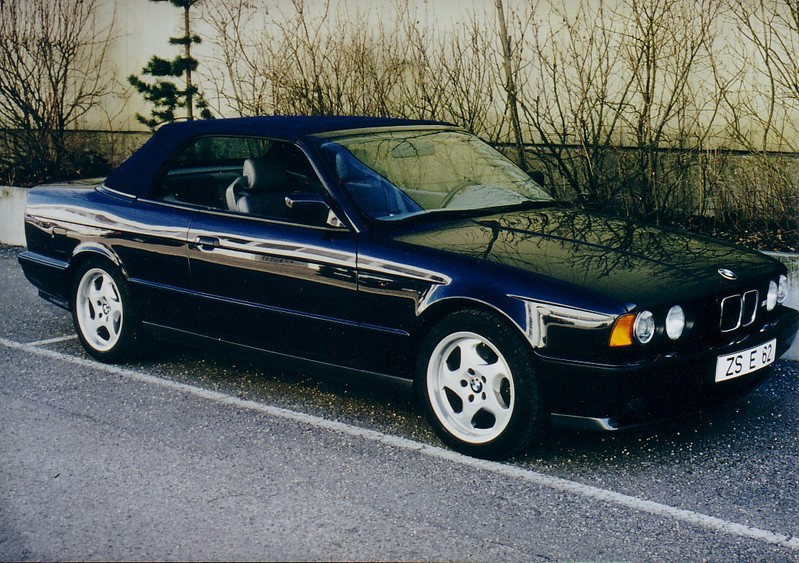 BMW M5 E34











 2010 Honda Accord

